Assessment and Progress
Personalised Assessment and Curricula
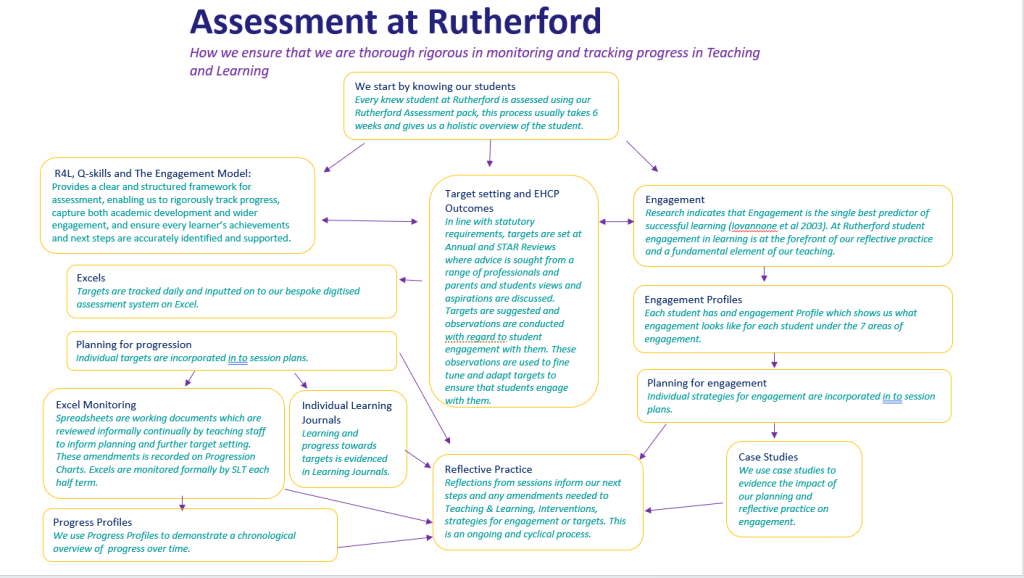
At Rutherford School, we recognise that progress is more than academic achievement, taking a holistic view of each young person’s learning journey. Our assessments and curricula are designed to meet the unique needs of every learner, building connections across skill areas to support meaningful development.
Using Routes for Learning, Prerequisite Skills for Learning (Q-Skills), and the Engagement Model, we gather data that helps us monitor, celebrate, and build on progress. We also use ASDAN accreditation to develop independence, resilience, and the joy of learning.

What Progress Looks Like
Ongoing, personalised assessment sits at the heart of our approach. We ensure that each learner’s strengths and needs, as outlined in their Education, Health and Care Plan (EHCP), guide their day-to-day and long-term learning journey.
Through detailed assessments, personalised planning, and careful tracking, we provide accurate, realistic information about current attainment while identifying opportunities for development. Our assessment models help us understand the type of learner each young person is, recognise achievements from the smallest steps to generalised skills, and plan the next steps that empower our learners to progress confidently.
Empowering Engaged Learners Through Multisensory Curriculum Approach
At Rutherford School, our multisensory curriculum enables young people with profound and multiple learning difficulties to engage actively in their learning. Using sensory exploration, movement, sound, and visual stimuli, learners develop focus, spatial awareness, and meaningful interaction with their environment. This approach helps our students overcome barriers, unlock their potential, and enhance their quality of life.
Personalised Learning Pathways
We know that progress is not linear. At Rutherford School, we use incremental, carefully planned steps to support progression. Our Excel-based tracking system monitors progression against ‘met’, ‘partially met’, and ‘not met’ criteria, ensuring a clear, objective record of achievements.
We hold multidisciplinary discussions to agree next steps, enhance engagement, and shape effective learning plans. Enrichment opportunities such as leisure activities, summer school, therapy sessions, and bespoke interventions help each learner maximise their potential while promoting enjoyment and independence.
Tracking Progress and Providing Tailored Support
At Rutherford School, we closely track each learner’s progress towards their EHCP goals, keeping education, health, therapy, and care outcomes at the centre of what we do. Our multi-disciplinary team provides detailed reports, sharing progress and next steps with families and professionals. We ensure Looked After Children receive personalised support and provision, so every learner benefits from the care, education, and opportunities they need to thrive.
Education and Welfare Provision for EHCP and EAL Learners
Rutherford School offers integrated education, therapy, and care for learners with EHCPs, ensuring a truly individualised approach. For learners who speak English as an Additional Language (EAL), we work closely with families and specialist staff to support language acquisition and cultural needs, ensuring full participation in learning and the wider school community.
Academic Performance
Students at Rutherford do not take standardised tests, goals are personalised to each learner and are ambitious and realistic. In the previous academic year, Rutherford School learners achieved notable progress across their personal and academic pathways, with measurable outcomes recorded through our Excell recording, assessment tools, ASDAN units and Life Skills. These results reflect the resilience, determination, and progress of our learners as they prepare for their transition to adulthood.
Our Approach to Assessment
At Rutherford School, assessment is integral to teaching and learning and directly linked to our curriculum. We use three broad forms of assessment:
- In-School Formative Assessment
- Enables teachers and teaching assistants to monitor performance and adjust teaching.
- Allows therapists to assess progress against therapy targets.
- Provides parents with insights into their child’s strengths and areas for growth.
- In-School Summative Assessment
- Supports school leaders in monitoring progress and planning interventions.
- Enables teachers to evaluate learning at the end of units.
- Keeps parents informed about achievements and progress.
- Informs EHCP reviews and STAR meetings.
- Tracks progress using Routes for Learning, Q-Skills, and the Engagement Model.
- Supports the tracking and moderation of ASDAN unit completion.
- Nationally Standardised Summative Assessment (ASDAN)
- Enables leaders to monitor progress against national standards.
- Helps teachers align their expectations with national benchmarks.
- Provides parents with context about their child’s progress compared to peers nationally.
At Rutherford School, our commitment to personalised assessment and progress tracking empowers learners with profound and multiple learning difficulties aged 16-25 to achieve meaningful, life-enhancing outcomes. Through robust assessment models, interdisciplinary collaboration, and tailored, creative learning opportunities, we ensure that each learner’s journey is dignified, personalised, and focused on unlocking their potential for a fulfilling future.